
Faisal Al Hassan
This interview was originally published in Hadara Magazine, Issue 14, Spring-Summer 2026
Faisal Al Hassan is the director of 421 Arts Campus in Abu Dhabi’s Mina Zayed district. Over the past decade, he has guided the evolution of a repurposed industrial space into a platform that nurtures emerging artists and serves as a connection point for the creative community. As 421 marks its 10th anniversary, Al Hassan reflects on continuity, capability building, and being the catalyst for change.
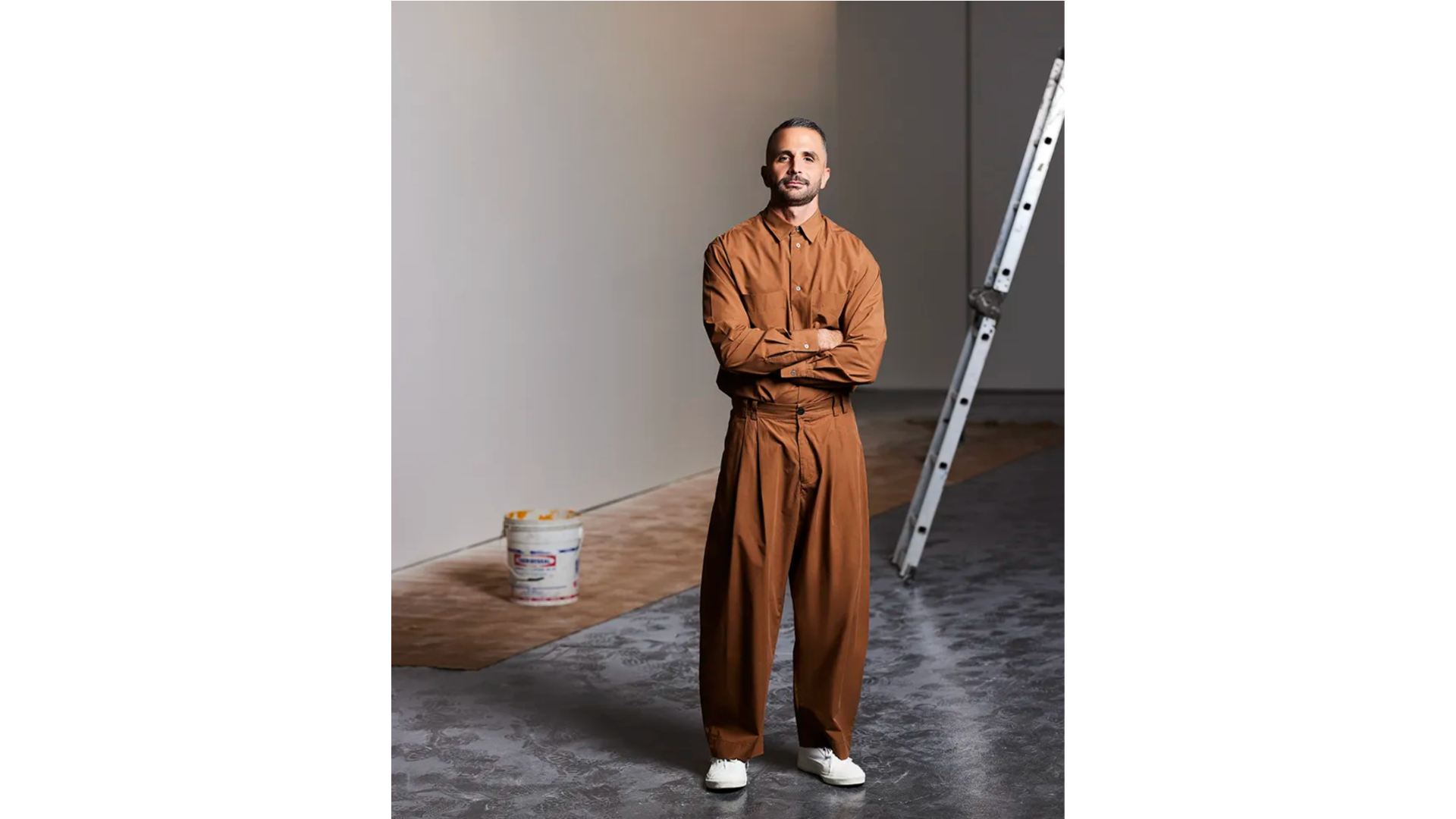
Faisal Al Hassan. Photo by Sam Rawadi.
What are you working on?
Faisal Al Hassan: We’re marking our 10th anniversary with Rays, Ripples, Residue, an exhibition that reflects on how artistic and exhibition-making practices have grown alongside 421. Curated by Munira Al Sayegh, Nadine Khalil, and Murtaza Vali, it examines a decade of production in the UAE and asks how experimentation can be supported with greater intention and care over the next decade.
Ten years in, how has 421 changed?
The mission was there from the beginning: to be a platform for emerging creative practices. A space that prioritises research, learning, and experimentation. A decade on, that remains, but the work has become more deliberate and infrastructural. What began as a gallery space in a warehouse has evolved into an arts campus shaped by sustained engagement with artists, curators, and the wider creative community. We’ve learned that impact is built through continuity rather than spectacle. Prioritising process over product has led us to focus on capability building.
When did you realise that 421 could make a difference?
There have been amazing successes in terms of exhibitions, but when I look back it is more about the quieter shift in how 421 is perceived. For me, when people started to reference 421 in the areas of community and capability building, that was when I realised the work was having an impact. I look at the shift, too, in how artists view and think about their work. I would love to track that—how a proposal starts, how it evolves, and what it looks like when it eventually opens to the public. I’ve seen artists take bigger and bolder risks, and these are the moments that stay with me.
How do you balance being a local space with broader institutional ambitions?
For 421, being local is not a positioning strategy; it’s the basis of our work. Mina Zayed is not a backdrop but an active context that shapes how the campus is used, who it serves, and how programmes unfold. This grounding allows us to remain responsive rather than prescriptive. At the same time, we operate within a rapidly expanding cultural landscape. Our role is not to mirror large-scale institutions, but to complement them by holding space for experimentation, risk, and development. Through collaborations such as Colomboscope, we connect practices from the UAE to wider SWANA [South West Asia and North Africa] and global conversations, while maintaining our autonomy. Our ambition is to deepen rather than scale, strengthening artistic ecosystems from the ground up.
What is next for 421?
We approached the 10th anniversary as a moment of reflection and recalibration. Ten years offer enough distance to reflect critically on what has worked, what has shifted, and what kinds of support structures artists now need in a changing cultural landscape. We’re asking ourselves how we can continue to be catalysts for change and continue to make an impact. To do this, we need to build capability beyond exhibitions. We need to home in on the programmes we have today, enabling research and experimentation through residencies and grants, and pushing these initiatives further.