
The Language of Humanity
This piece was originally published in Hadara Magazine, Issue 14, Spring-Summer 2026
Rachid Koraïchi’s fascination with symbols is a constant shaping his deeply considered practice.
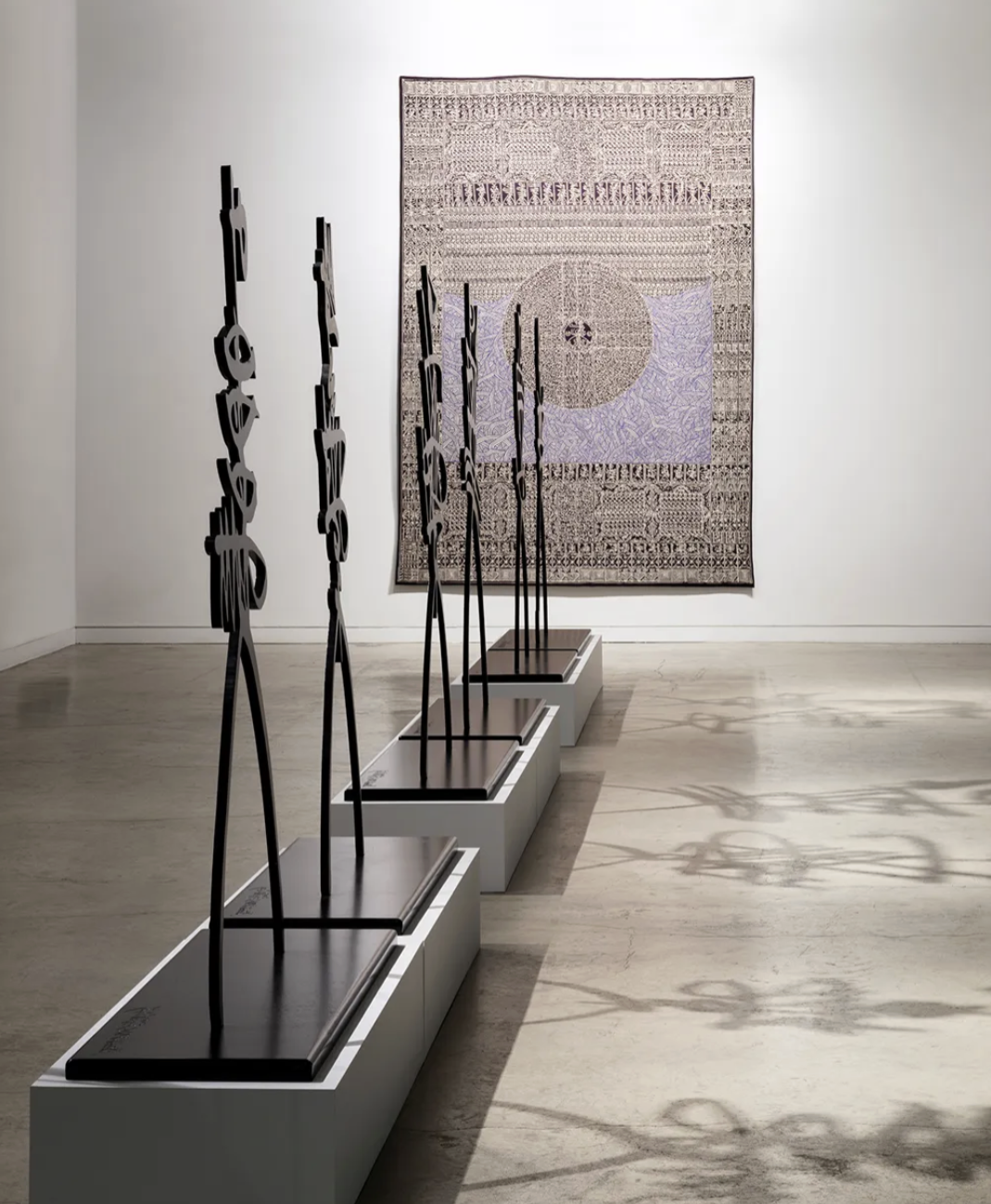
Les Vigilants, la Nuit (2021), black corten steel sculptures, and Jardin d’Afrique (2021), woven tapestry. Installation view at the exhibition Le Chant de l’Ardent Desire at Aicon Art, 2022. Photo courtesy of Aicon Art.
Sculptor, ceramicist, painter, and spiritualist, Rachid Koraïchi has had a five-decade, internationally recognised career. Algerian by birth, raised in Tunisia, and now based between Tunisia and Paris, his work has appeared in major collections and biennials around the world. Yet this season marks a significant first: a major solo exhibition at Sharjah Art Foundation.
At the core of Koraïchi’s practice is an invented visual language—intricate symbology inspired by Sufi philosophy and Islamic geometry, interwoven with memory and ancestry. “My art emerges from a single source: myself,” he says from his home in Paris. “I draw on my own memories, spiritual beliefs, and family lineage.”
That ancestry runs deep. “I come from a family of resistance fighters and builders,” Koraïchi explains. “My ancestors helped found the city of Kairouan [a UNESCO World Heritage site in Tunisia, important in Islam]. The Blue Qur’an was created by them, using a distinctive calligraphic form known as the Kufic of Kairouan. I can also trace my lineage back to the Quraysh—the family of the Prophet Muhammad. This genealogy explains my lifelong engagement with Sufism and mystical thought,” he says.
Despite his strong regional ties, Koraïchi has never had a solo exhibition in the UAE. His work is part of the Barjeel Art Foundation collection and has appeared many times at both Abu Dhabi Art and Art Dubai. Perhaps his most significant local showcase, until now, was in the 2014 exhibition Seeing Through Light, where his large installation Le Chemin de Roses was revealed as part of the Guggenheim Abu Dhabi collection. There, hundreds of small steel sculptures—cut in symbolic patterns, drawn in part from Tifinagh, an ancient geometric script with roots stretching back at least 2,500 years, but mostly from his own imagined language—cast intricate shadows across the gallery walls, resonating not through literal meaning but through visual rhythm and mystical intensity.
Koraïchi also works across textiles, print, painting, and ceramics, often in collaboration with poets and calligraphers. In 2011, he was awarded the Jameel Prize, an international award for contemporary art inspired by Islamic tradition, for embroidered cloth banners from his series Les Maîtres Invisibles (2008), which honoured spiritual masters of Sufism.
In recent years, he has expanded into architectural projects, including the construction of memorial cemeteries that embody his commitment to the sacred dignity of humanity.
In southeastern Tunisia, in the coastal town of Zarzis, Koraïchi funded a cemetery, Le Jardin d’Afrique (the Garden of Africa), for migrants who died crossing the Mediterranean Sea. The idea was sparked by a photograph. “[People] left without dignity,” he recalls. “I couldn’t believe it until I saw it myself.” He was moved to act. Koraïchi purchased the land, designed the site, and with support from his daughters, oversaw the construction of a sanctuary for remembrance. Hand-painted tiles line the space and the grounds are planted with jasmine and citrus trees.
In 2005, he created the Jardin d’Orient (Garden of the Orient) at the Château Royal d’Amboise in France’s Loire Valley in homage to Emir Abdelkader, Algeria’s 19th-century resistance leader. Today, “I am working on a third cemetery near Cannes, in memory of Algerians who suffered during the early years of foreign rule,” he says.
“All of these projects capture what my work seeks to express: memory, spirituality, dignity, and the invisible bonds that unite humanity across time, geography, and belief.”
Coming to Sharjah for this major exhibition is, he says, deeply emotional. Sharjah’s cultural vision resonates with him, and he praises its efforts to offer visibility to African artists. “Too often, African artists remain invisible,” he says. “There is hardly a museum in the world that doesn’t hold African works, yet the artists’ names are rarely mentioned. Sharjah’s cultural vision seeks to heal this fracture by bringing African creativity into the light.”